Workflow
Question to solution
Move from an open question toward a bounded, reviewable output instead of stopping at an isolated generated answer.
AI for scientific discovery workflows.
Alpha Omega Labs
Alpha Omega Labs is building the workflow layer between an open scientific question and a reusable research result. The goal is not only to generate text, but to help technical teams produce manuscripts, code, artifacts, and reviewable research context that can be challenged and rerun.
Workflow
Move from an open question toward a bounded, reviewable output instead of stopping at an isolated generated answer.
Outputs
Keep the manuscript, code, and artifact bundle together so the result can be inspected, reused, and shipped onward.
Continuity
Preserve review notes, lineage, and rerun context so each pass improves the next one instead of resetting the workflow.
What we build
Alpha Omega Labs is building infrastructure that helps technical teams move from difficult questions through simulation and experimentation to reusable research outputs without losing traceability on the way.
Scientific-discovery workflows
Turn an open technical question into a bounded workflow with clearer scope, execution, simulation, experimentation, packaging, and follow-up.
Reproducible outputs
Keep the paper, code, and artifact bundle together so a result can be reviewed, shared, and reused later.
Research memory
Preserve lineage, review notes, reruns, and prior context so the system compounds instead of resetting every session.
Governed deployment
Build with a visible path from hosted access to private, policy-aware deployment when organizational requirements rise.
Why us
The value proposition is the full workflow: not only finding sources, not only generating drafts, and not only fitting one narrow domain surface.
Angle 01
The system is designed to move from a hard question toward a reusable output package that can be reviewed, shared, and rerun.
Angle 02
Manuscripts, code, artifacts, review notes, and rerun context belong in one research workflow instead of across disconnected tools.
Angle 03
The platform direction is intentionally broad across STEM and life sciences so the workflow can support multiple categories of advanced technical work.
Angle 04
The commercial path stays visible from the start: hosted access first, then clearer governance, BYOK, and private deployment options.
Fields and applications
The near-term focus is on technical fields where faster exploration, simulation, experimentation, and retained research memory change what smaller teams can realistically discover and build.
Field
Field
Explore theory-heavy or simulation-heavy questions where technical framing, evidence packaging, and iteration matter as much as the first answer.
Field
Field
Support workflows around quantum systems, algorithms, and reservoir-style reasoning where experiments, notation, and review need to stay attached.
Field
Field
Compress early material-search and technical hypothesis cycles when smaller teams cannot afford a full internal discovery stack.
Field
Field
Help technical teams iterate on model, systems, and optimization questions with stronger packaging than a notebook or chat transcript alone.
Field
Field
Create a better workflow for difficult mathematical reasoning where formal structure, derivation traceability, and review matter.
Field
Field
Open room for structured discovery workflows in bioinformatics, molecular reasoning, and related life-science research settings.
Research publications
These publication cards stand in for real paper screenshots, code bundles, and evidence packages from the kinds of demanding workflows the platform is designed to support.
Flagship platform
omegaXiv is the flagship platform from Alpha Omega Labs. It connects public discovery, private execution, paper workspaces, and reusable research packaging inside one operating surface.
Marketplace and discovery
A public layer where problems, papers, tags, and review signals make it easier to find credible work and decide where to engage.
Private research workspace
Private run workspaces keep pipeline state, quality signals, costs, and rerun actions together while a question is still being worked through.
Paper, code, and artifacts
Publication workspaces keep the manuscript, artifacts, and review surface together so outputs remain legible and reusable after the run ends.
Problem intake and launch
Problem pages carry the brief, runtime assumptions, and launch controls so new work starts from structured context rather than an empty chat session.
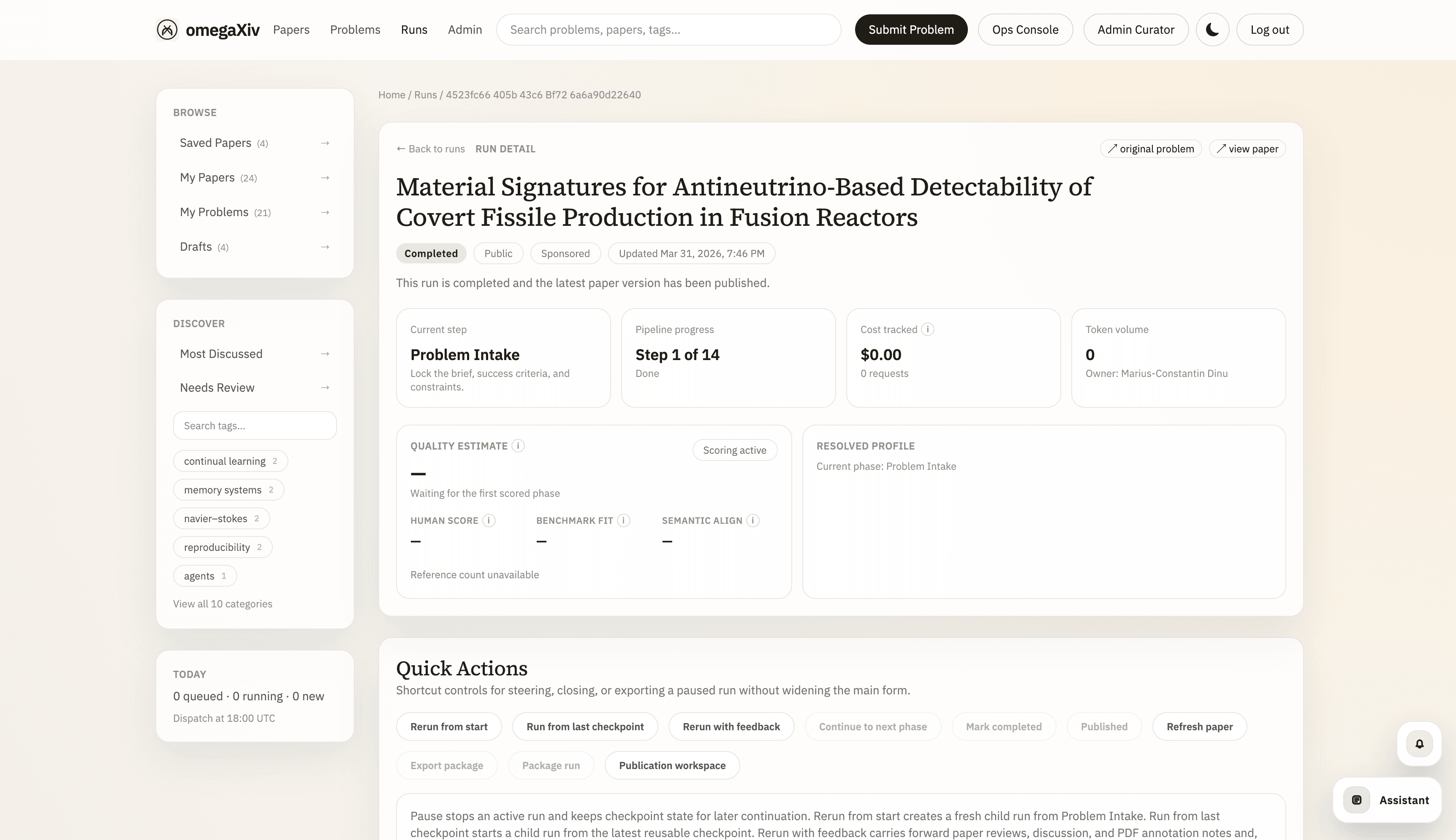
Research execution
Run detail keeps pipeline progress, quality tracking, cost visibility, and next actions in one private workspace while the research is still active.
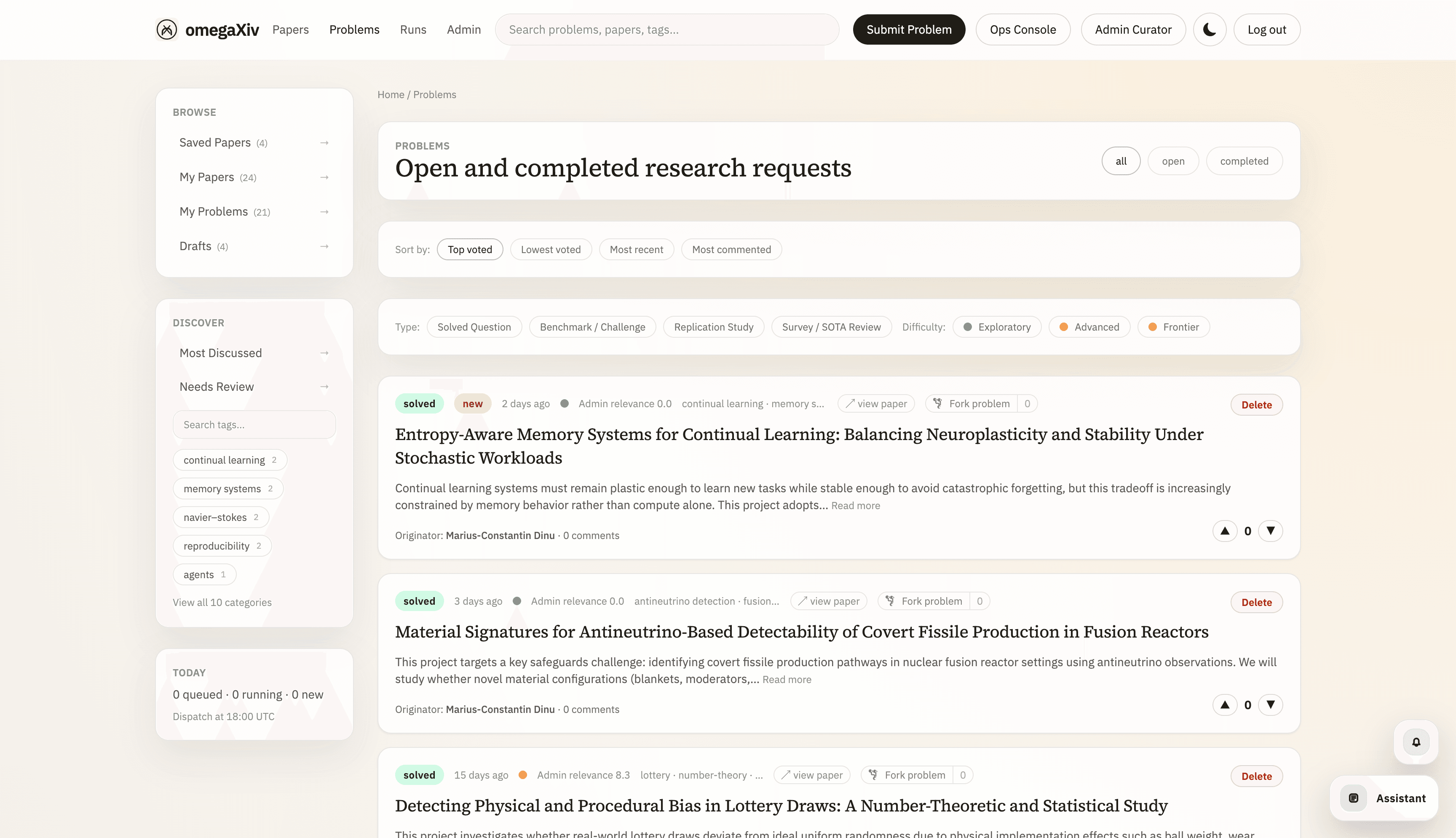
Public discovery
The discovery feed surfaces active research requests, tags, review context, and paper links so promising work can be found and evaluated in public.
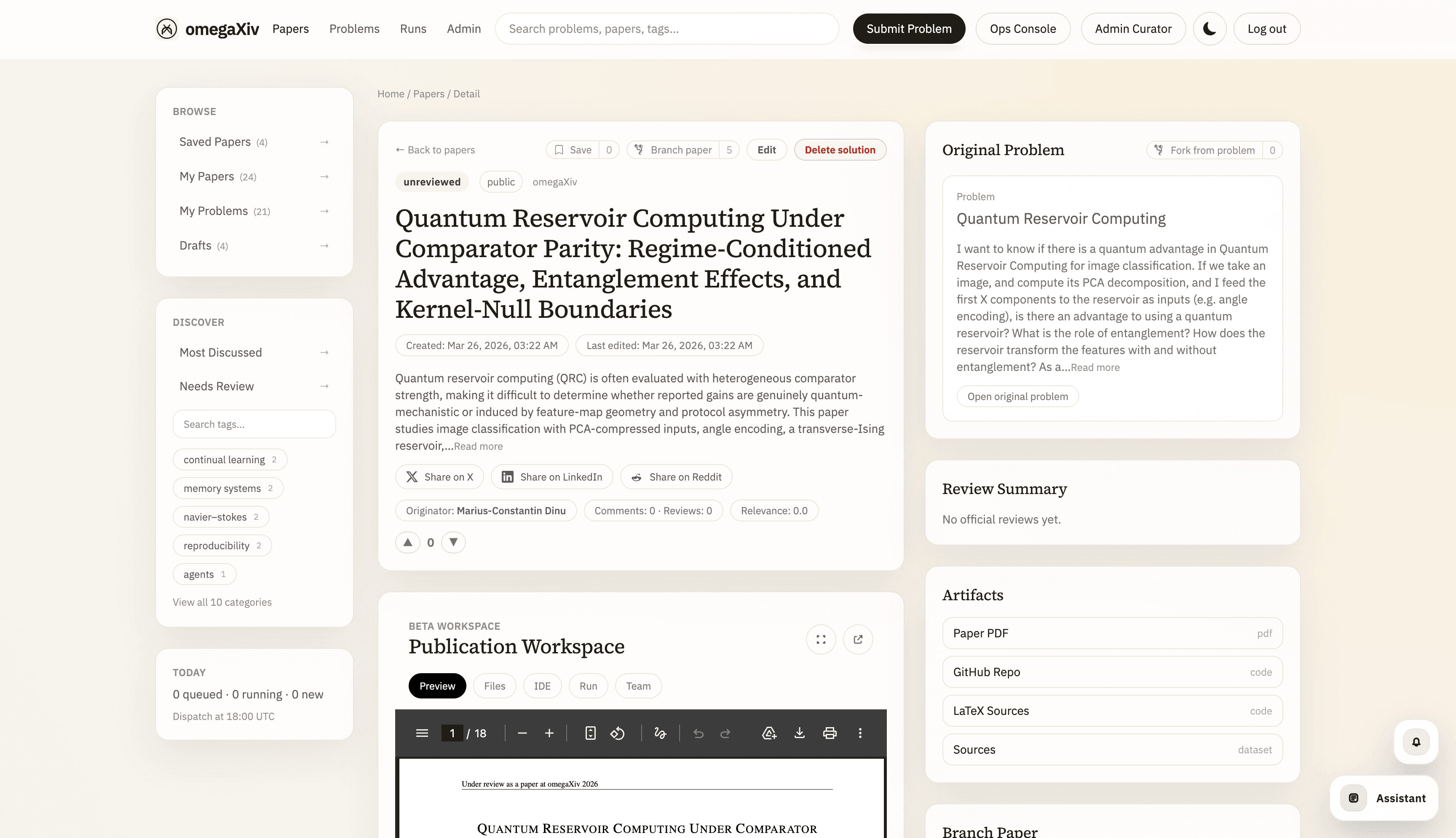
Publication package
The paper workspace keeps the manuscript, artifact bundle, source problem, and publication controls together so outputs can be reviewed, shared, and reused later.
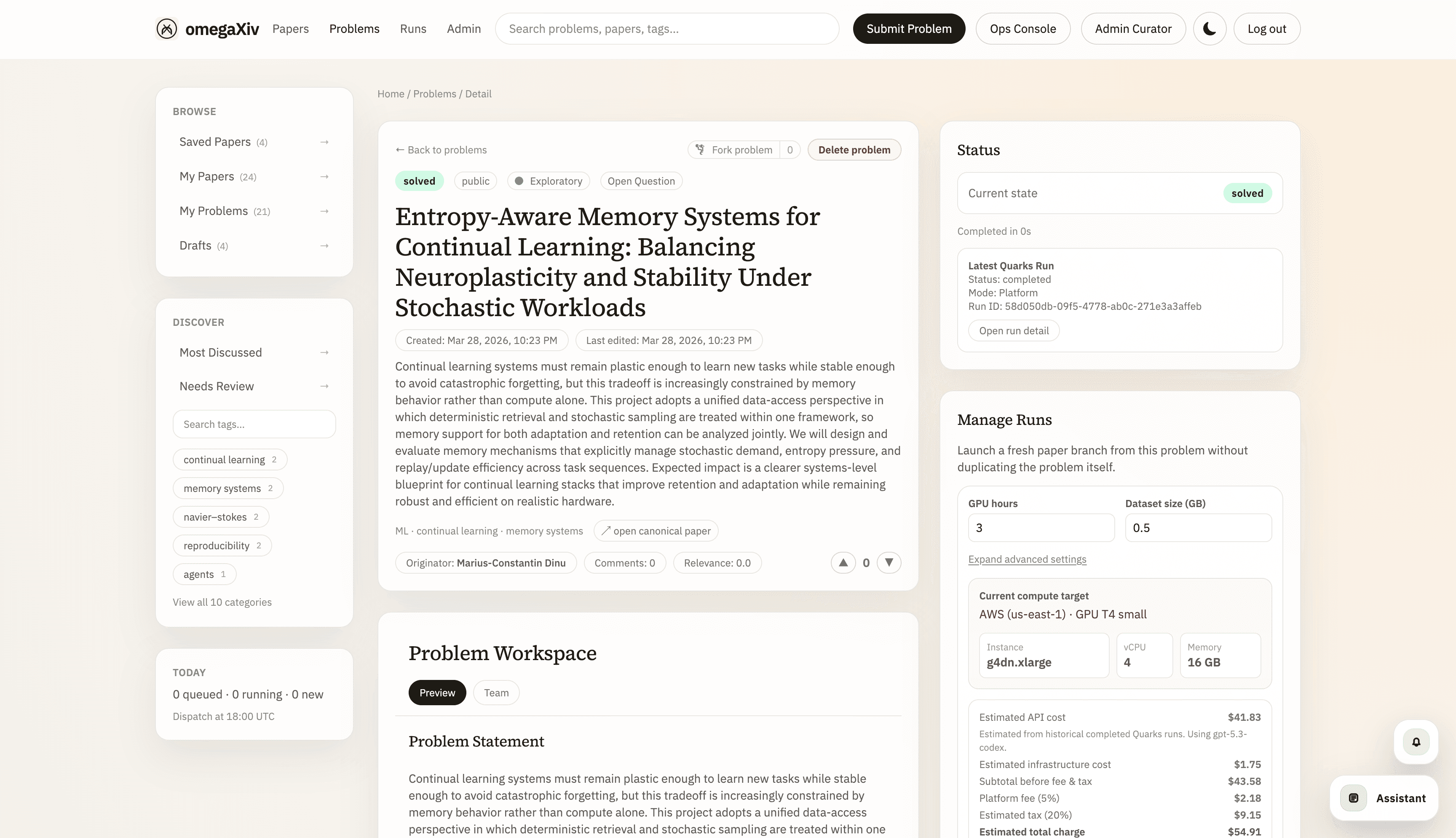
Structured intake
Problem detail gives teams a structured starting point: the brief, current status, run history, and launch configuration all stay attached to the same research object.
Research workflow
The workflow should read as a bounded scientific loop: define the problem, explore, package the result, review it, and carry the learning forward.
01
Start with an explicit scientific or technical question that can be framed, scoped, and evaluated instead of a vague prompt.
Good research workflows begin with a bounded problem definition.02
Run structured exploration that produces candidate approaches, evidence, technical outputs, and a clearer sense of what is worth pursuing.
The emphasis is on orchestrated exploration, not one-shot generation.03
Package the manuscript, code, and supporting artifacts together so the result is easier to inspect, compare, and reuse.
The work should travel as a research package, not a chat log.04
Bring the result into review, challenge, comparison, and rebuttal once it is ready to be tested against stronger scrutiny.
Symbolic validation is part of the workflow, not an afterthought.05
Feed what was learned back into the next run while keeping lineage, notes, and previous artifacts attached to the process.
Research memory should compound across iterations.Trust and deployment
The trust layer matters because scientific work cannot live only as a demo. It needs packaging, review, privacy controls, and the option to govern how the workflow is deployed.
Early-stage technical ideas, commercial research, and sensitive experiments should stay private until the team decides they are ready for broader scrutiny.
Outputs should remain attached to the manuscript, code, and supporting artifacts so the work can be inspected and rerun later.
Review, rebuttal, and rerun loops belong inside the workflow so quality improves with use instead of relying on after-the-fact cleanup.
Hosted access should lead naturally into BYOK, policy controls, and private deployment when governance requirements increase.
Latest news and blogs
This section can carry release notes, research notes, and company updates now, then evolve into a fuller blog or newsroom later.
Lab note
A place for deeper writing on scientific-discovery workflows, product direction, and what the team is learning from early users.
Follow the updatesProduct update
A place for platform milestones such as workflow packaging, review loops, private workspaces, or deployment-path improvements.
See the product directionCompany update
A place for pilot announcements, partnership notes, and new areas where Alpha Omega Labs is expanding the research workflow surface.
Start a conversationTeam and advisors
The lab is led by a compact founding team and supported by scientific and strategic advisors whose work spans research depth, product direction, and real-world deployment.
Founders and advisors
Founding team
Leads the research direction, scientific vision, and core knowledge base behind Alpha Omega Labs, shaping the scientific thesis, platform, and long-term product direction for the lab.
Founding team
Leads business intelligence, systems architecture, and infrastructure scaling so Alpha Omega Labs can turn demanding research workflows into durable, operable systems.
Advisor
Machine-learning pioneer and scientific advisor with deep experience in neural-network research, systems thinking, and long-range AI direction.
Advisor
Cognitive scientist, author, and public voice on AI reliability, evaluation, and scientific reasoning across research and industry.
Advisor
Theoretical physicist and AI strategist connecting scientific depth with commercialization, policy, and applied deployment.
Partners and technology
The network around the lab spans research collaborators, applied-AI partners, and the execution stack used to run discovery, simulations, experimentation, packaging, and deployment, with room to evolve into real AI-factory infrastructure for scientific and technical R&D.
Network and collaborators


Simulation and experimentation
The workflow is built not only to write and package results, but to run simulations, experiments, validation passes, and artifact-backed iteration inside the same operating layer, including private or on-prem environments where traceability, controlled execution, and repeatability matter.
AI-factory infrastructure
The stack spans public discovery, private workspaces, cloud storage, reproducible packaging, and deployment paths that keep serious technical work operable over time, including policy-aware and on-prem-ready setups for teams working under AI Act or comparable regulatory requirements.
Technology and infrastructure





Careers
The current openings are representative of omegaXiv hiring priorities: high-ownership roles across data, ML, and platform systems.
Data Systems
Build the ingestion, curation, and artifact pipelines that keep research workflows reproducible, searchable, and cost-aware.
Apply via emailApplied ML
Improve ranking, retrieval, and evaluation systems that help the platform decide what to run, surface, and refine next.
Apply via emailPlatform and Reliability
Own runtime, deployment, and observability foundations for long-running research execution and publication workflows.
Apply via emailRequest access
The first conversation should clarify which R&D workflow you want to build, which simulations or experiments belong inside it, which outputs matter, and how private or governed the system needs to be from day one.
What we need to know
R&D workflow design and partnerships
contact@omegaxiv.orgResearchers and technical builders
A design session for turning a demanding scientific or technical question into a reusable workflow with the right execution, simulation, experimentation, and packaging structure.
Labs, startups, and R&D teams
A scoped pilot for teams that want to move beyond standard omegaXiv workflows and shape their own research pipeline on top of the stack.
Governance-minded organizations
A conversation about private infrastructure, policy-aware controls, and how to run your own internal R&D workflows with the same stack under stricter operational requirements.
Community and social
These are the public touchpoints for release signals, lab writing, hiring updates, and community discussion as the platform grows.
Discord
Join the public Discord for product updates, research discussion, early workflow feedback, and pilot-community conversation.
Join the DiscordNewsletter
Get milestone updates, launch notes, research dispatches, and invitations to new public surfaces as they open.
Join the newsletterSubstack
Long-form lab notes, workflow essays, and research-output commentary will live here as the writing surface opens.
Substack coming soonX / Twitter
Short-form release notes, milestone signals, and public announcements will appear here when the channel goes live.
X / Twitter coming soonCompany updates, hiring signals, partner announcements, and institutional milestones will be published here.
LinkedIn coming soon